
Why choose Valencia to learn Spanish?
Valencia brings together a coastal setting and a balanced city life, favourable to regular practice of Spanish.
The city lets you keep a good balance between language progress, personal pace and quality of life.
Language course
Valencia
Spain
Work on your Spanish in a well-balanced coastal city, with concrete practice day after day.
Valencia brings together a coastal setting and a balanced city life, favourable to regular practice of Spanish.
The city lets you keep a good balance between language progress, personal pace and quality of life.
Valencia combines modern life and a coastal atmosphere, suited to steady and comfortable learning of Spanish.
Local weather
Forecast loading
The weather is displayed automatically according to the city.
Destination
Local time
Local time
Your time zone
825 948 inhabitants
A large Mediterranean city, between the old town, the Turia, the City of Arts, beaches and lively districts.
Spain's third city in terms of population lies on the shore of the Mediterranean Sea, in the east of Spain, facing the Balearic Islands. Valencia is about 360 km from Barcelona, to the south, and from Madrid, to the east. It is the capital of the Valencian Community, positioned between Catalonia, to the north, Murcia, to the south, and Castile-La Mancha, to the east. The city enjoys a semi-arid Mediterranean climate, which gives it hot summers, with rare rainfall, and mild winters whose temperatures only rarely drop below 10°C. The amount of sunshine is high.
Valencia was founded in 138 BC by the Roman Republic and saw its first growth in the 1st century with the building of a forum, an arena and a river port. The Christianisation of the city in the 4th century gave way to the Arab invasion and the Islamisation of part of Spain. That era lasted until 1238, the date the city was taken by James I of Aragon. The Kingdom flourished during the Valencian Golden Age with the construction of many civil and religious buildings. A cosmopolitan city through its history, Valencia offers visitors festivities as well as a cuisine based on the Mediterranean diet and on rice, such as the famous paella.
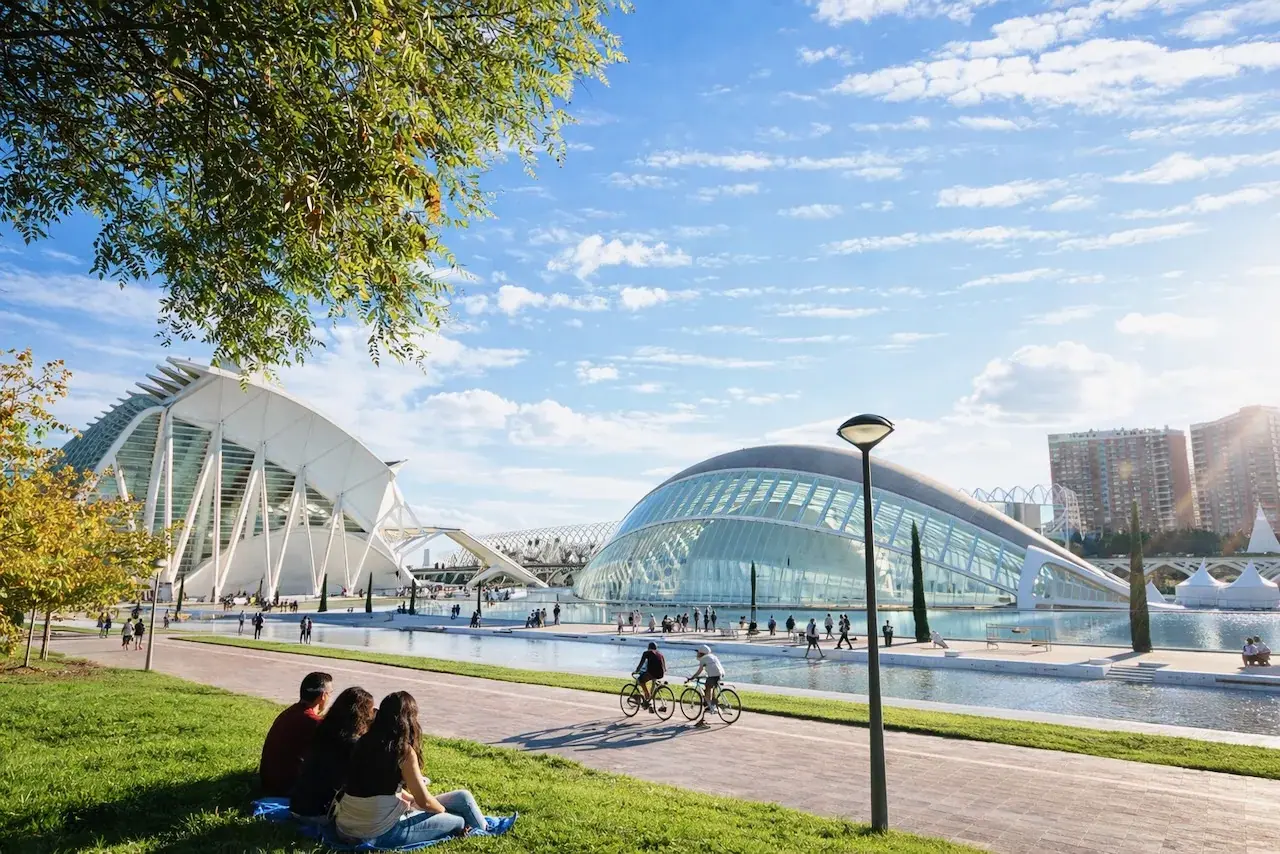
Going to Valencia is a chance to discover the Albufera nature park, the Devesa del Saler, or the various gardens: botanical garden, Monforte gardens... The old bed of the river Turia, diverted to prevent flooding, made it possible to build the Institute of Modern Art, Gulliver park, sports facilities and above all the City of Arts and Sciences, which houses the shaded garden and the largest aquarium in Europe. The seafront paseo is a chance to enjoy a paella, with a view over the fine sandy beaches, and even to watch the fallas parade.
Valencia has very high quality transport infrastructure with the international airport, positioned to the west of the city, only 8 km away. Valencia is connected to Barcelona and Madrid by rail. Urban transport consists of three metro lines and two tram lines. For shopping, the main areas of interest are in the Jardín del Turia, between the Nou d'Octubre and Astilleros bridges, in the city centre, and in the Orriols district.
Getting there: high-speed train from Madrid: 1 h 40 min