
CLIC
Language courses
in Cadiz
Language course · Move and Study
Cadiz
Spain
- Climate : more than 3,000 hours of sunshine a year
- Airport : Jerez, about 40 km away
- Population : ≈ 115,000 inhabitants
- 1 school
Improve your Spanish on the Atlantic coast, in the oldest city in western Europe.
Cadiz: 1 school. Homestay accounts for 52% of a 4-week budget on average. Last check of this page's rates: October 18, 2026.
Why choose Cadiz to learn Spanish?
Cadiz is a human-sized place to study, far from the bustle of Spain’s big cities, with a strong Andalusian accent and a lively neighbourhood life.
Between beaches, city walls and the lanes of the old town, you combine lessons, constant exposure to the language and life by the sea.
Find my language stay in Cadiz
Our schools in Cadiz
1 school available
Price of a stay in Cadiz
Cadiz at a glance
Cadiz packs more than three thousand years of history onto a narrow peninsula, which makes it a dense, compact place to immerse yourself in Spanish.
Local weather
Local weather
Forecast loading
The weather is displayed automatically according to the city.
--:--
Destination
Local time
--:--
Local time
Your time zone
The city in brief
Living environment
Living environment
An Andalusian port city built on a narrow peninsula between the Atlantic Ocean and the bay, ringed by city walls and urban beaches.
Map & landmarks
The map is temporarily unavailable.
Cadiz sits at the tip of a narrow peninsula in south-western Spain, in Andalusia, on the Atlantic coast. Founded by the Phoenicians around three thousand years ago, it is considered the oldest continuously inhabited city in western Europe. It lies about 120 km from Seville and more than 600 km from Madrid; the nearest towns are Jerez de la Frontera and El Puerto de Santa María. The climate is oceanic, tempered by the Atlantic: milder and windier than inland, with summers less stifling than in Seville and mild winters.
City life and landmarks
history & culture
The history of Cadiz goes back to its foundation by the Phoenicians, who are said to have settled it as Gadir about three thousand years ago, making it the oldest continuously inhabited city in western Europe. Cadiz then saw Carthaginian, Roman and Muslim rule before the Christian reconquest. A favoured port for trade with the Americas from the 18th century, the city hosted Spain’s first Constitution in 1812. Today, Cadiz is still famous for its Carnival, one of the liveliest in Spain, and for an old town of narrow lanes and shaded squares.
Read moreShow less
things to do / to see
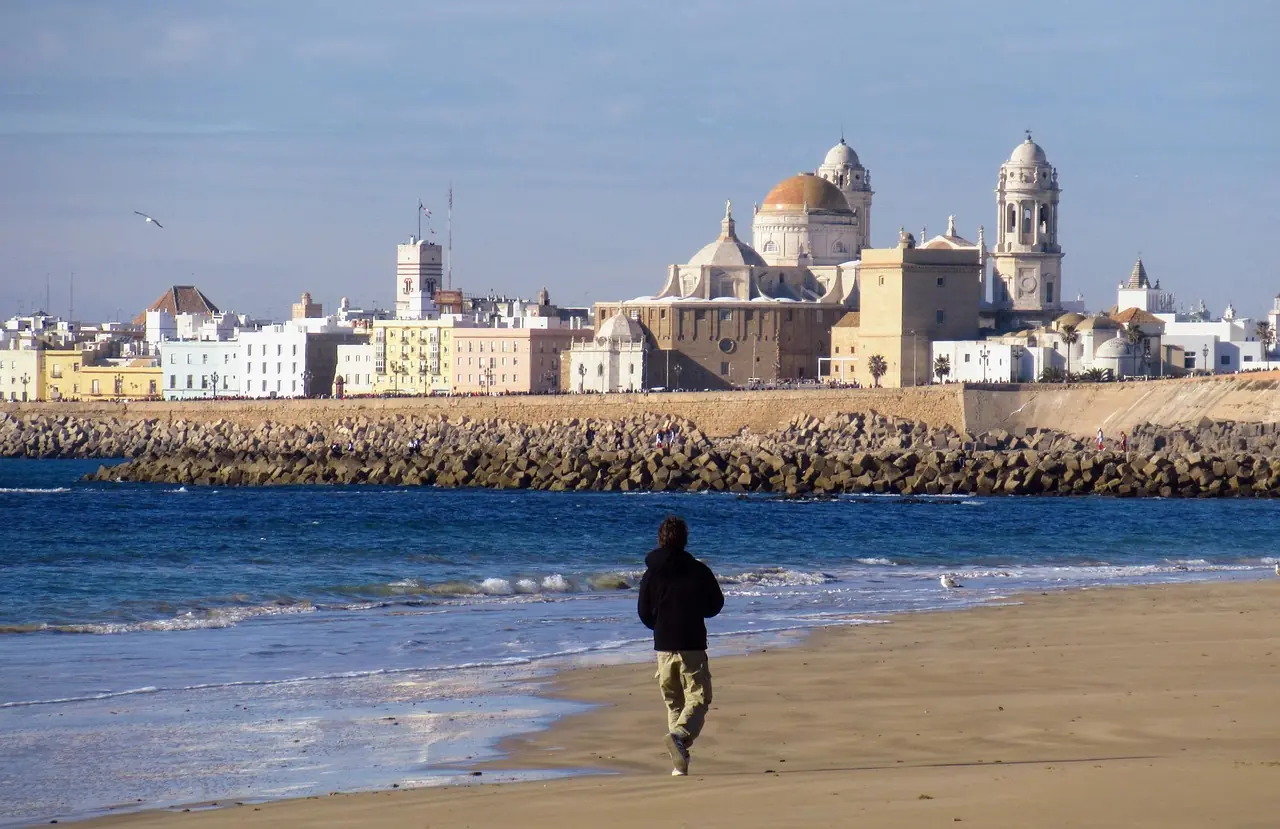
Cadiz is surrounded by the ocean almost all the way round, with several urban beaches within walking distance of the centre, including Playa de la Caleta and Playa de la Victoria. Its heritage includes Cadiz Cathedral (Catedral Nueva), the Tavira Tower, the Roman theatre and the walls that encircle the old town. The La Viña district, known for its tapas bars and fried fish, is the heart of the nightlife. The Cadiz Carnival, in February, is one of the best-known popular festivals in the country.
the city in practical terms
Cadiz has no airport of its own: the nearest is Jerez de la Frontera, about 35 minutes away by car or train. Cadiz station connects the city with Seville and Madrid by high-speed train. In town, the old quarter can be covered entirely on foot; city buses serve the outlying districts such as Playa de la Victoria. The central market (Mercado Central) and the shops of Calle Compañía and Calle Columela make up most of the local shopping.
- Climate : sea at about 22 °C in summer