Why choose Berlin to learn German?
Berlin combines the pace of a capital with cultural depth, a solid context for improving your German.
The city lets you keep a good balance between language progress, personal pace and quality of life.
Language course
Berlin
Germany
Improve your German in a cultural capital, in a demanding and stimulating environment.
Berlin combines the pace of a capital with cultural depth, a solid context for improving your German.
The city lets you keep a good balance between language progress, personal pace and quality of life.
Berlin offers a very rich cultural setting and a dense city life, useful for connecting the German learnt in class with real daily practice.
Local weather
Forecast loading
The weather is displayed automatically according to the city.
Destination
Local time
Local time
Your time zone
3 685 265 inhabitants
A major cultural capital where parks, lakes, forests and lively neighbourhoods remain close to the centre.
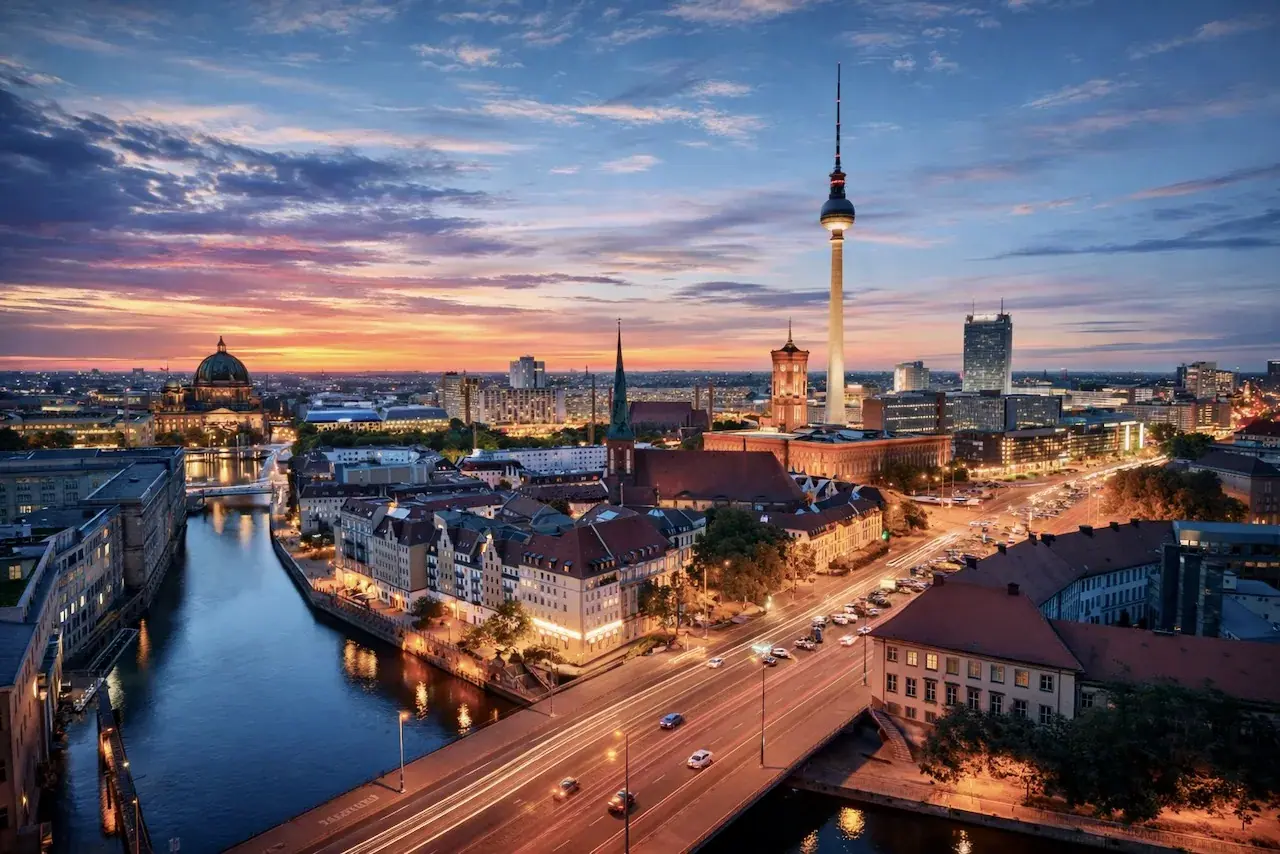
Berlin is located in the north-east of Germany, at the confluence of the Spree and the Havel in the German-Polish plain, dotted with rivers and lakes such as the Mügglesee. The climate is continental, with wide variations between the seasons: cold, dry winters and hot summers that are sometimes stormy. The capital is also divided into 12 boroughs: Spandau, Reinicken-dorf, Pankow, Mitte, Charlottenburg-Wilmersdorf, Steglitz-Zehlendorf, Tempelhof-Schöne-berg, Neu-kölln and Treptow-Köpenick.
The history of the city of Berlin is linked to the history of Germany. Founded in 1244, the city joined the powerful Hanseatic League in the Middle Ages, before becoming a refuge for large Jewish and Huguenot communities from 1685 onwards. Berlin then established itself as the capital of the Kingdom of Prussia in 1701. It kept that status until 1945, with the fall of the Third Reich. With the Cold War, the city was divided by the Berlin Wall, which came down in 1989, setting off the German reunification movement. Now the federal capital, it is currently a major tourist destination, thanks to a very strong cultural ferment and a particularly lively nightlife. The city thus has 166 museums, 142 libraries and 60 theatres. The symbol of this new appeal is Museum Island, a UNESCO World Heritage Site.
Do not hesitate to wander the paths of Tiergarten Park, right in the city centre, which stretches over 3 km. Head as well for the Botanical Garden, home to 22 000 plant species. To take in the wealth of the architectural heritage, simply go to Museum Island, the Unter den Linden avenue, the Brandenburg Gate or Alexanderplatz. Make your way into West Berlin to visit the Kulturforum, with its modern and innovative architecture, a site that hosts the Berlin Philharmonic and the national gallery... Finally, let yourself be won over by Berlin’s lively nightlife in the Mitte district, with its many bars and clubs.
During your language course in Berlin, you will have the chance to use the German capital’s dense public transport network: from the underground to the bus, by way of the tram. In support of its soft-mobility policy, the city of Berlin has more than 130 km of cycle paths. For shopping, the city has plenty to offer, starting with the vast KaDeWe shopping galleries on Wittermberg Platz.
2 schools available