Why choose Munich to learn German?
Munich has a balanced urban rhythm, favourable to lasting progress in German.
You move forward at a sustained but controlled pace, between study time, real exposure to the language and clear organisation.
Language course
Munich
Germany
Improve your German in a cultural capital, in a demanding and stimulating environment.
Munich has a balanced urban rhythm, favourable to lasting progress in German.
You move forward at a sustained but controlled pace, between study time, real exposure to the language and clear organisation.
Munich remains a good mix of culture and activity, with the learning of German firmly anchored between the structure of lessons and real practice.
Local weather
Forecast loading
The weather is displayed automatically according to the city.
Destination
Local time
Local time
Your time zone
1 603 776 inhabitants
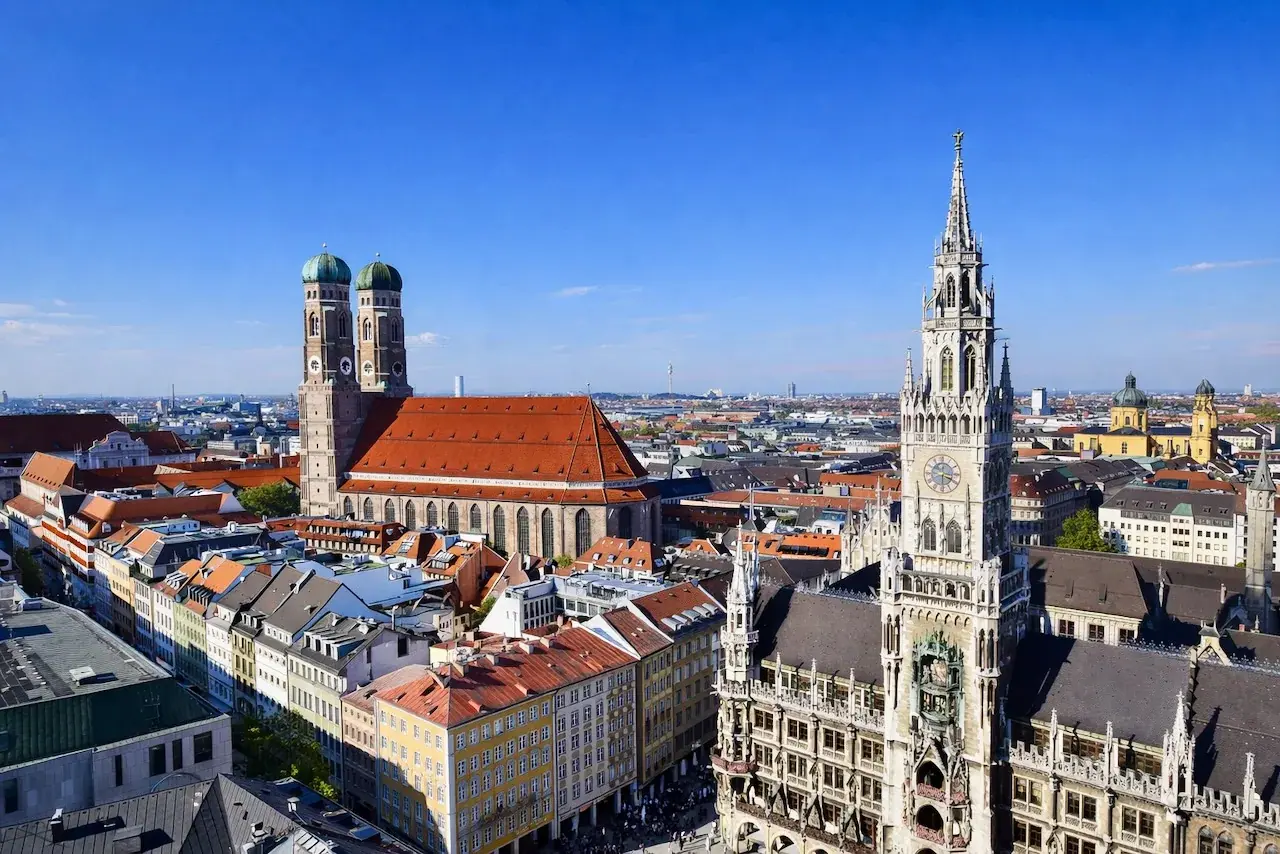
A major Bavarian capital, between the old town, museums, beer gardens, parks and the English Garden.
Setting off on a language course in Munich means heading for one of the largest German cities in terms of area. The Bavarian capital lies in the south of the country, not far from the Austrian border. The river Isar crosses it over some 14 km, forming in particular the museum island. Munich has several large lakes, including within the city itself. This geographical position gives it changeable conditions, a careful blend of an Atlantic and a continental climate. Alternation is the rule, between sunshine, rain and snowfall, helped by the closeness of the Bavarian Alps.
The history of Munich begins in the 9th century, when a village was built next to a Benedictine abbey. The city’s emblem, a little monk, recalls the origin of its name Munichen, meaning "at the monks’ place" in Old German. The city of Munich only began to grow in the 12th century, when the Duke of Saxony gave it a market and fortifications. In the 13th century the duchy of Bavaria was entrusted to the count palatine Otto von Wittelsbach, whose dynasty would rule Bavaria until 1918! Munich came into its own during the 19th century, becoming a city of international economic, cultural and artistic standing. Largely destroyed during the Second World War, Munich would heal its wounds before rising once and for all from its ashes at the 1972 Olympic Games.
During your language trip to Munich, you will appreciate the beauty of the monuments, masterpieces of the rococo and neoclassical periods, that adorn the Bavarian capital. Once your German lessons are over, you will set off to discover Königsplatz and MarienPlatz. Stepping through the doors of Die Residenz and Nymphenburg, you will be dazzled by the beauty of the castles of the kings of Bavaria, witnesses to the wealth and power of that dynasty. You will visit the city’s famous art galleries and taste the Bavarian art of living in the shade of the biergarten, so pleasant in summer. Alive with an undeniable joie de vivre, as the festivities of the famous Oktoberfest show!
So, during your language course in Munich, you will take the U-Bahn, the S-Bahn, the tram or the bus, as you prefer. The cost of living in Munich is generally higher than in France.
1 school available