Why choose Dublin to learn English?
Dublin offers the bearings of an accessible capital, with good conditions for working on your English.
The city lets you keep a good balance between language progress, personal pace and quality of life.
Language course
Dublin
Ireland
Improve your English in a balanced urban centre, well suited to continuous immersion.
Dublin offers the bearings of an accessible capital, with good conditions for working on your English.
The city lets you keep a good balance between language progress, personal pace and quality of life.
Dublin offers varied city life, useful for making progress in English with everyday interactions that are easy to fit in.
Local weather
Forecast loading
The weather is displayed automatically according to the city.
Destination
Local time
Local time
Your time zone
592 713 inhabitants
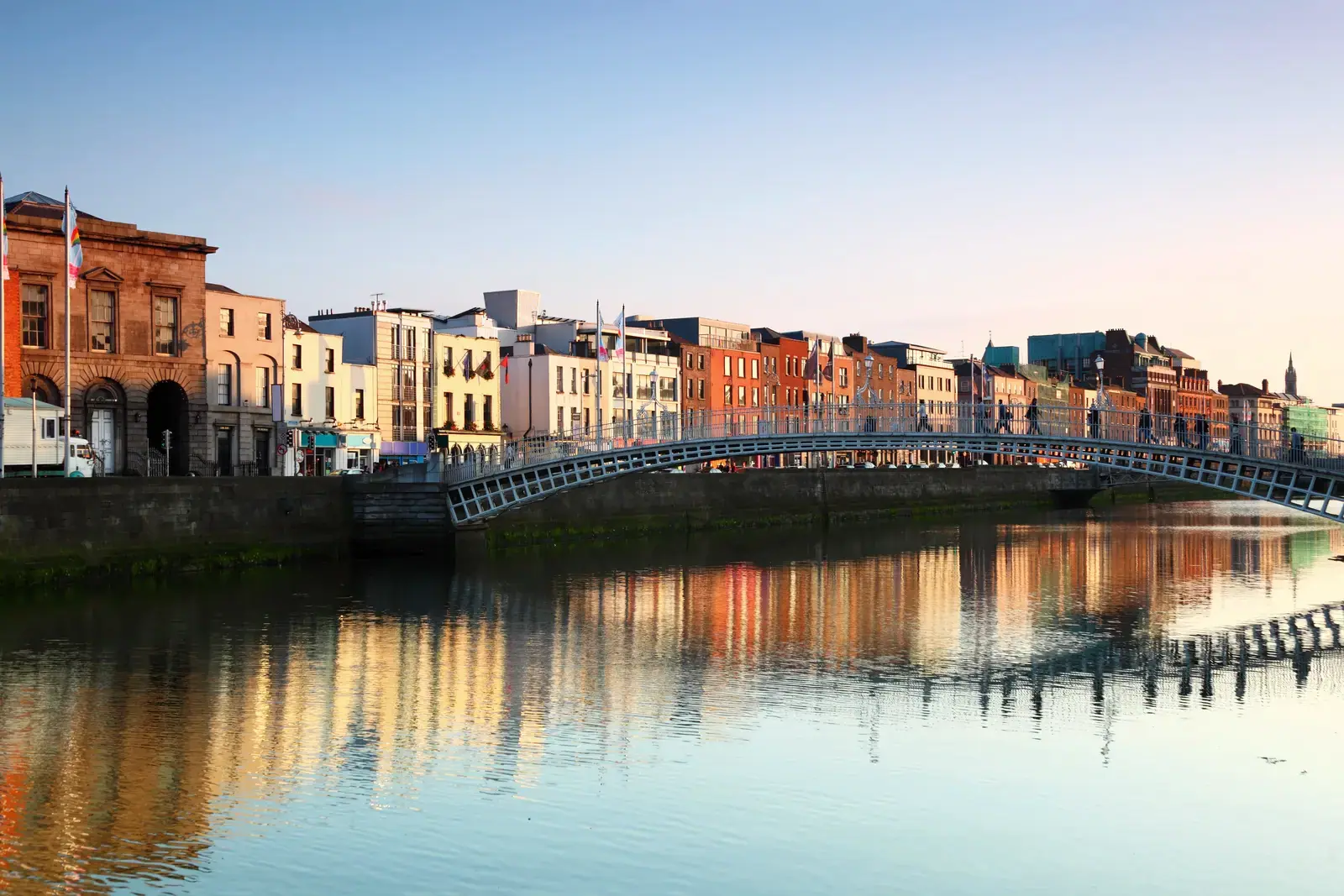
A compact capital, between the River Liffey, museums, urban parks and quick access to the sea.
The city of Dublin sits on the eastern coast of the Irish island, at the mouth of the River Liffey, which crosses the Irish capital from west to east. Dublin Bay lies in the Irish Sea, the stretch of water that separates Ireland from Great Britain. The city is 45 kilometres from the Welsh coast and 95 kilometres south of Belfast, the capital of Northern Ireland. The city has a typically oceanic climate, with fairly mild winters, marked by an average temperature hovering around 5°C, and cool summers. Rainfall is plentiful throughout the year.
Originally a village of fishermen and farmers, Dublin was conquered in 837 by a Viking invader named Thorgis. The Vikings were, however, driven back in 1014, after the battle of Clontarf in the north of the city. The region was conquered by the Anglo-Norman peoples, who absorbed Dublin in 1169. The religious differences setting Catholics against Protestants left a deep mark that lastingly affected Ireland and its capital. The latter then saw significant growth in the 18th century. The 1916 uprising and the war against England subsequently led to the loss of many old Dublin monuments, but in this way the country managed to gain its independence. Dublin officially became the capital of the Republic of Ireland in 1921.
The region offers many restorative natural sites such as the lush Phoenix Park, Saint Stephen's Green or the Garden of Remembrance, reached from Parnell Square. The city is also full of historic and cultural sites such as Trinity College, Christ Church and Saint Patrick's cathedrals, Dublin Castle and the National Art Gallery museum ... to be visited without moderation! With its many unique local sports, you will also have the chance to visit Croke Park, the major centre of Gaelic sports. The picturesque atmosphere of the city is friendly, lively and festive everywhere, conducive to meeting people and to an immersive language course abroad. Dublin also hosts and organises many festivities such as the Taste of Dublin, Bloom's Day and so on. At the weekend, take the time as well to enjoy a famous Guinness with a local Fish'n'Chips in a pub!
The city has an international airport in the town of Swords, 11 kilometres north of Dublin. Two tram lines are also available, linking Sandyford to Stephen's Green and Tallaght to Connolly Station. The cost of living there is reasonable, similar to the tourist centre of Paris. The unmissable shopping spots are also around Temple Bar, Henry and O'Connell Street.
3 schools available